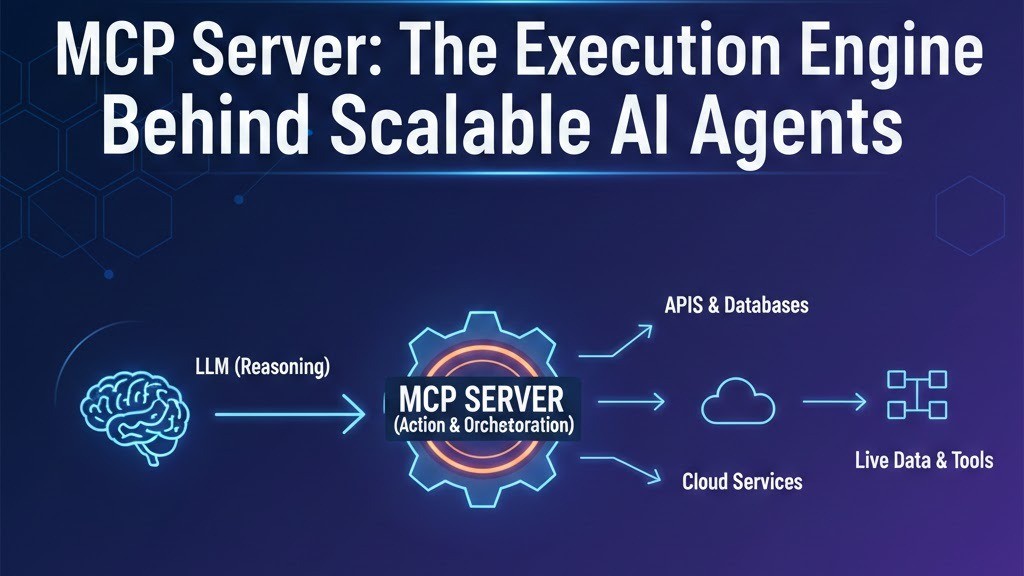
LLMs know how to reason. But without tools, they can’t act. MCP is how we bridge that gap: dynamically, safely, and at scale.
What Is an MCP Server?
An MCP (Model Context Protocol) server is a powerful concept that turns your AI model into a true system operator.
It’s a standard interface that lets LLMs discover, understand, and use tools dynamically.
With MCP, the AI doesn’t just respond. It takes action using:
- APIs
- Databases
- Cloud services
- Functions
- Live data tools
No code-level integration. No hardcoded logic. No model redeploys.
Why Traditional Tool Binding Fails at Scale
Let’s say you want your LLM to send emails, call an API, or query a database.
The typical method looks like this:
- Write the prompt
- Attach the function call schema
- Hardcode which tools the LLM can use
- Retrain or redeploy when tools change
This doesn’t scale:
- Every change means a code edit
- Every new tool means a full redeploy
- There’s no dynamic discovery
Why an MCP Server Fixes This
With an MCP server, you shift to dynamic orchestration:
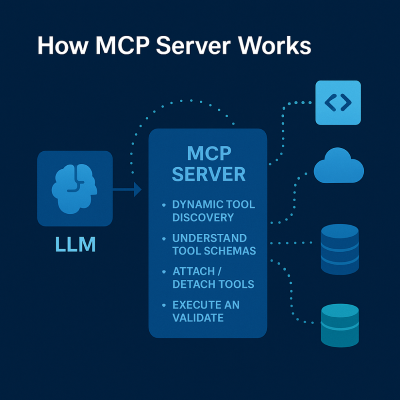
- Register tools once, not in every script
- List and describe tools through the
tools/listrequest - Add or remove tools on the fly
- LLMs fetch updated tools at runtime
- Structured input and output schemas for every tool
- Safe tool calling with validation and fallback
In short: live control over what your model can do, without touching your LLM code.
Where MCP Fits in Modern AI Systems
A modern AI architecture includes three layers:
- LLM: reasoning
- RAG: retrieval
- MCP: action and execution
RAG brings knowledge. MCP enables action. Together, they create a smart, capable agent.
Use cases include:
- Customer support agents
- Workflow automation
- AI copilots
- Intelligent search and trigger systems
- Any tool-using assistant
Real-World Benefits
Here’s what you get when using MCP:
| Feature | Without MCP | With an MCP Server |
|---|---|---|
| Tool discovery | Static | Dynamic at runtime |
| Tool registration | Manual, hardcoded | Schema-based and declarative |
| Adding new tools | Requires coding | Plug and play |
| Error handling | Ad hoc | Standardized and validated |
| Scalability | Hard | Modular, enterprise-ready |
Final Thought
If you’re building AI systems that need to scale, don’t bake tools into code. Expose them through an MCP server.
It’s like giving your model a live plugin system: secure, flexible, and future-proof.
MCP turns your AI from a chatbot into a platform.